















Wind no match for die-hard anglers
Published April 26, 2011
There is an adage that states, “where there is a will, there is a way.” That statement is the best way I can describe how die-hard fishermen are catching fish with all of the high winds lately.
The “way” is in taking advantage of the effects of the strong southeasterly winds that flood the secondary or back lakes and bring high tide levels all around the Galveston Bay complex.
One of the places that offers sheltered water from the adverse winds is upper Chocolate Bayou. Bryan Treadway, who keeps up with fishing in the bayou reported some excellent catches taking place.
Treadway has a couple of suggestions for helping anglers catch fish under current conditions and that is to use small baits. He used as an example crappie jig-sized baits. Shrimp are going through their annual migration and are scarce in Chocolate Bayou. Most of the baits camps report sparse to no supplies of live shrimp. Avoid shrimp imitation baits and stick to what the fish are feeding on, he said.
Pods of mullet are common along Chocolate Bayou and for that reason he thinks Super Spook Juniors would be a good choice of bait in areas where fish are feeding on mullet.
Capt. Bubba Ray, Big Three Guide Service, has been capitalizing on the flooded back lakes and marshes. Ray and his charters have been catching lots of nice slot reds. In fact, during the past three days the popular fishing guide estimates at least 50 reds in the 5- to 8-pound range being caught with easy limits being taken.
Top waters and gulps fished under popping corks have been the best baits. The best action has taken place before 10 a.m. with most of the fish coming from Greens and Jones Lakes and the back of Halls Lake. Protected shorelines are where the fish are hanging out.
Perry Chapman found protected water in the channel between Galveston Bait and Tackle and Payco Marina. Sunday, he along with his brother Ted used dead shrimp to land six sheepshead, two puppy drum and three stingrays, the largest estimated to be 3-feet wide.
On the beach front, Richard Belleau, 61st Street Fishing Pier, reported his customers landing sand trout, croaker, whiting and slot reds. Early Monday the wind was gusting to 30 knots along the beach front.
To get your catch in the Reel Report, phone Capt. Joe Kent at 409-683-5273, or send an email to reel.report(at)galvnews.com. There’s no charge for this service.
Spring Explosion
String or Swim
by Jeremy Chavez
http://castingtales.wordpress.com/articles/string-or-swim/

The topic seems to rise annually as the doldrums of a harsh winter, by Texan standards, begin to set in and anglers’ recollections are of warmer times and better fishing. Every winter the great debate is regurgitated in some form or fashioned by those, myself included, whose hope is to catch that fish of a lifetime. THE FISH that every avid saltwater angler here on the Texas coast hopes to one day encounter the fang-toothed, yellow-mouth, speckled beauty of our inshore waters. The seemingly attainable yet ever elusive holy grail: the 30” Spotted Seatrout.
Retain or release? Exhibit the beautiful specimen of creation on a wall or desk, or release it back into the wild unscathed. Well, virtually unharmed, other than a puncture wound, a little fatigue, and the recollection of another near death experience.
Why can’t you have your cake and eat it too?
I have pondered this theoretical question on many occasions when I first became obsessed with targeting big trout. The debate, at its core, boils down to whether you consider a big trout a prized possession. This argument holds no substance for those that believe the contrary; people that see a big trout as nothing more than two generous filets on a frying pan. But this argument is not for them, the outsiders. There’s no point in trying to sell ice to an Eskimo.
I am and will always be a redfish-junky at heart, but big trout, especially pot-belly leviathans, carry with them an aurora that is irrefutable and not easily forgotten. If you’ve ever hung into a gator you know what I mean. If you have not had the pleasure, bear with me as a try, i.e. fail, to explain the experience.
There’s no mistaking the brute power or bend in your rod as it’s doubled over when a big trout is trying to emancipate itself from the end of your line. Each violent head shake translated directly into the palm of your hands. Every surface thrashing creates excitement and anxiety simultaneously. Your heart rate escalated; each beat feeling like it might burst through your chest as you try to subdue the formidable adversary.
After the battle has commenced, and you finally grasp your paws around the broad shoulders of a mature female trout you don’t spoil in triumph. You envision things many people overlook. You don’t just see fins and scales. You see genuine beauty. You see an animal that has endured and beat improbable odds. You see a story told through size, old age and wisdom. You are humbled, and accept success, while honoring the opposition with respect and due care.
There is just no feeling quite like it. It’s impossible to explain, yet extremely addictive. The experience will leave you with an insatiable appetite for more.
You’ll spend hours scouring over reports, maps, satellite images, tide charts, and solunar tables trying to increase your odds at an encore; most of the time it’s a fruitless effort. Year after year you are outsmarted by a creature with brain capacity nowhere near the level of your own.
Contrary to popular belief, the struggle is not always as discouraging as it may seem. More often than not it’s your motivation to brave the elements. It provokes you to do things you would not do otherwise, such as fishing during sub-freezing temperatures with no feeling in your extremities while knee deep in mud or fishing all day marathons from crack of dawn to well after the sun has dipped below the horizon. There are countless days when you question your sanity while convincing yourself to keep grinding because any cast might be the fish you have been longing for.
Why the debate?
Keeping trophy sized fish doesn’t make any sense to ME for a number of reasons, but if someone decides to do so it’s their prerogative, and hopefully, a well thought out and informed decision. With the progression of technology, both fish mounts and cameras, there’s no real basis to keep trophy fish anymore other than egotistical motives or certain death of a landed fish.
All the justification tossed around for keeping big fish is just that, rationalization as to why to retain trophy fish. All this talk about survival rates, spawning cycles, and genetics are moot points.
I don’t want to get into numerical stats because that is not what this is about. There’s no disputing fact, but there’s also no disputing common sense. A released fish will always have a greater chance at survival over one that has been retained. Therefore, a released fish will always been given the opportunity, if just once, to reproduce again. But these are only minor reasons for releasing big fish in the grand scheme of things.
Fish mounts have come a long way from their archaic past. Photos and measurements, both length and girth, are all that is needed to produce a high quality fiberglass replica that will outlast a traditional skin mount. Quality point and shoot digital cameras, even waterproof models, are very affordable and easy to use. Most cell phones today have higher quality cameras than what was available on the market not too long ago.
Anybody recall the old adage “a picture is worth a thousand words”?
Buy a camera that fits your budget and learn how to operate it and always keep it at your disposal. There’s no better way to recollect the memory of that once in a lifetime catch than an old-fashioned still shot. The grin on your face will tell the story.
Nobody cares for those who like to brag. It’s a natural predisposition to want to show off a grand accomplishment, but there’s a fine line between doing so humbly or arrogantly. Those who fish for egotistic reasons have a skewed perspective, as do those who keep big fish as a means to boast. If bragging rights is your motive for fishing then you have the wrong pastime.
Fishing is a means to relax and have a good time in the outdoors with or without the company of others. As a human being, we not only experience nature we are a part of it. As a result, we are responsible for the consequences on how our footprint affects others.
There are also many people who keep trophy fish simply because they don’t realize what they have in their possession. They don’t know the story behind, i.e. the close encounters with death, every inch it took that trout get to reach its elderly years. We, as anglers who care about and enjoy the resource, can’t fault these people. We can only hope to educate them.
Digest this discourse with a grain of salt because, as I stated before, I have not caught a trout over 30”, but I have been close. About an inch shy to be exact, but who’s counting? My personal philosophy is to release every trout over 25” mainly due to aforementioned reasons plus trout usually don’t start to get fun until they reach 5lbs. I don’t believe I have ever kept a trout over 23″ either.
I don’t wish or expect others to do the same because it’s a personal decision. I release mature trout because I appreciate the life story told by their size. I enjoy the pursuit much more than I enjoy their taste or petrified appearance. I get all warm and fuzzy inside when I see such a majestic beast swim away full of vigor.
I have never regretted releasing a big fish. If I am not the last person to catch that fish then it was more than worth the effort. Maybe someone else will understand the magnitude of what they caught and gain perspective as a result. Maybe that fish and I will cross paths later in our existence, hopefully with a fatter gut and lankier physique. Maybe she’ll win the next battle and be “the one that got away.” The fish that leaves me heart-broken and even more determined than ever before. Maybe I’m just getting sappy at my old age.
Just my II sense…
Anatomy of a Cove
Anatomy of a Cove
By Captain Steve Soule’
The “Shallowist”
Wow, I wish the 15th of the month would quit sneaking up on me so fast, I feel sure that 30 days took a lot longer to pass ten years ago. It’s time for an article again, and I thought I would try to give up some useful information about Galveston’s West Bay. Let me start by saying that although West Bay is on the smallest bays in the Galveston complex it may well be the most diverse in terms of the types of terrain that can be found, and there’s no question that the bay can be a top-notch producer throughout the year. There are numerous features within this little bay; shallow flats, deep guts and reefs, miles of shoreline, and a major gulf pass. Of all the features of this bay, I would have to rank the coves of the south shoreline among the best and most diverse available to Upper Coast anglers. I’m going to attempt to describe what type of features can be found within these coves and how fish relate to them.
I’ll start with the outside or front of the coves, where they open to the bay. The first noticeable feature is visible when passing from mid-bay; it is the point of land that defines the cove. These points are usually covered with grass, with a mud and clay mixture as the shoreline gives way to the bay. The immediate point area is often tricky to wade especially around the western point on the side facing back to the north and east. It’s a small area but is very slick and often uneven and requires a little effort to wade without falling. The opposite point (westward facing) is the one that I find greater interest in. It is off of this point that you will find the natural barrier that protects the cove. This barrier is visible along some coves. Dana and Carranchua coves are perfect examples, in front of both you can still see a group of small grass islands. Other coves such as Hoeckers and Bird Island are protected by a submerged sandbar. This sandbar is visible on low tides or when the water is very clear. In front of Jumbile and Maggie’s coves you will find some scattered shell. Whatever the makeup of the point, they can all be “fishy” at times, especially on the backside of the barrier where it drops off into the cove. In this area, the water is often dirtier that the surrounding areas and almost always hold some bait. Worth this area with a top-water plug and if that doesn’t produce try dragging a B&L Sea Slug or Bass Assassin through the dirty water, if you don’t find a trout you’re almost sure to find a flounder. One more spot at the front of the coves not to overlook would have to be the “mouth” as it drops out into the bay. This deserves special attention in the spring during the later stages of the outgoing tides when large schools of bait are often stacked up here.
As you work your way back into the cove you’ll find the western shoreline to be fairly firm, though not completely smooth. If you walk out away from the shore near the point you’ll eventually find the feeder gut that “fills and drains” the cove. In some of the smaller coves this gut is fairly noticeable and well defined. In some of the larger coves, like Dana and Bird Island for example, the gut widens rapidly as it enters the cove and may just appear to be a small drop that follows the shoreline on one side and the barrier or sandbar on the other. This is a feature of the coves that can easily be followed, and that’s exactly what the trout and reds do. On an incoming tide start wading from the back of the cove and walk the edge of the gun or drop-off out towards the mouth. Typically this is where the bigger concentrations of bait will be found and the big trout won’t be far behind.
Now I said I’d work my way out from the shallow back end of the cove, but the truth is that if I’m after redfish or flounder I usually won’t leave the back end of a cove at all. For most of us were limited by where our boats will take us or how “wade-able” an area is, if these are your limits you may never realized some of the most intense and exciting visually involved fishing that the Upper Coast has to offer. The backs of the coves, where they blend into the marsh, can absolutely load up with fish. What you’ll find back here is marsh shoreline, shallow flats that seasonally cover up with grass and numerous sloughs and drains that funnel water and creatures in and out with the tides. Basically ever cove in West Bay has marsh to some degree, the extent of which can’t be easily seen until you make the effort to enter and explore it. The back ends of the coves, by around May, will fill with small bait-fish, crabs and shrimp. They will stay bait rich all through the summer months and into the fall on a normal year. It is no coincidence that this is when the fishing will be most consistent. Though typically I don’t expect to find Big Trout in these shallows marshes they do show up at times. I normally work these areas for redfish and flounder, which frequent the shallows. Due to the fact that these marsh flats are so shallow and protected I’ll work them in a very slow and methodical manner. It never fails that when you get in a hurry you will spook the fish that right in front of you. I will fish the marshes with a soft plastic on a 1/8th ounce jig head; sometimes I’ll go lighter or even go to a weed-less rigged Bass Assassin when the fish get really spooky. Though I prefer to sight-cast, I certainly won’t walk an area without casting when I’m not seeing fish.
As you move around, some things to key in on are the little sloughs through the marsh and any point of land. These are structures that both bait and fish must move through or around. I have found that flounder have a strong tendency towards holding in these areas, waiting to ambush any unsuspecting creature that swims to close. Fish these back marsh areas on the incoming tide and you’ll notice that fishing get better as the tide rises. The rising tides flood the flats with forage for the predators. As the tide peaks the reds will often remain in the shallows until the water begins to fall back out. When the tide begins to fall I will do just like the flounder and take up station at the mouth of a slough or a narrow point here the marsh flows back out to the bay. Doing this allows me to intercept the fish as they move back to the deeper water. If this doesn’t prove fruitful, I’ll move out a little deeper and fish the drop into the gut in the main cove, often I’ll find trout waiting here to feast on the bait coming out of the marsh. This area out in front of the drains is great for going back to a top-water plug which may reward you with a few crashing guests.
Learning a cove from front to back can be a diverse and rewarding experience, where gaining this knowledge can often result in catching that elusive “bay slam”. As a matter of fact, it can be a fairly regular occurrence to catch trout, reds and flounder in one cove during the course of the day. If you’re interested in learning more about the coves of West Galveston or the opportunity to catch a “bay slam” visit me online at www.theshallowist.com.
2011 Big Trout Tournament
Winter Brings Fishing Tourneys


By Joe Kent
Correspondent
Published January 13, 2011 http://galvestondailynews.com/story/204290/
There will be a number of winter fishing tournaments around the Galveston Bay Complex, and one group active in hosting those events is the West End Anglers Fishing Club.
This year, the group will host its second Big Trout Tournament on Jan. 29.
It will be held in Sea Isle at the new West End Marina.
Guides are allowed. Information for registration can be found online at www.fishwest
end.com, or you can call Coe Parker at 713-594-4252.
This will be a live weigh-in tournament. Participants will receive a Fish West End T-shirt just for signing up to fish.
The entry fee is $60 and there is an optional side pot.
Door prizes and music will be part of the program.
The club’s fifth annual Black Drum Tournament is scheduled to start Feb. 1 and run until April 10.
This event gives everyone an excuse to get out and catch a trophy.
Twenty dollars gets you a shot at the 100 percent cash payout purse for first through third place.
The tournament is a CPR event — catch, photo and release.
According to the club’s news release on the tournament’s rules, the winner is determined by length of the fish. So, measuring your catch, photographing it with the appropriate color for that week or a time stamp on the photograph is all that is needed.
Participants are encouraged to deflate the air bladder with a proper venting tool then release the fish.
Any fish that does not swim off does not count. Great care must be taken to revive these very large, old fish.
All of the group’s tournament dates can be found on its website.
While everyone was doing their best to keep warm Monday morning, Jaime Ochoa, his father, Benito, brother Benito, and a family friend went fishing.
They fished the rock groins along the seawall, and, around 10 a.m., the bull reds started hitting.
Within an hour, the four anglers each had a big red, with the largest measuring 46 inches. Only three of the reds were retained as that is the number of red drum tags they possessed.
In addition to the reds, a 33-inch black drum was landed.
It appears we will have another day of this cold weather. However, by the weekend, a warming trend should start.
To get your catch in the Reel Report, phone Capt. Joe Kent at 409-683-5273, or send an e-mail to reel.report(at)galvnews.com. There’s no charge for this service.
Sight Fishers’ Guide
Sight Fishers’ Guide
~Captain Steve Soule'~
Sight fishing can be one of the most exciting ways to fish. It can also be one of the most challenging and complex. There are a lot of things that must come together to make a good sight fishing experience. Every day is different, in the things that you will see, reaction of the fish and the conditions that you will have to deal with. I have collected a lot of memories over the years and have always tried to put myself in situations where I can sight cast. By now, it’s safe to say that I have thousands of hours practicing my sight casting skills and learning from the fish. My experience has come from all over the Gulf of Mexico coastal waters, from Texas to Florida, and there a many consistencies that I have learned. I have put together a short (ish) list of some of the things that will come in handy to anyone who finds shallow water and sight casting of interest.
The location– First and foremost, if you want to be successful at sight fishing, you need to start in an area that holds fish. Now, not only does it need to hold fish, but they must be visible somehow. There are the obvious signs, tails, and other surface disruptions such as wakes or fish eating at the surface. Then there are some subtle details that can lead you to fish, surface activity from prey or bait species. Jumping shrimp, finger mullet, glass minnows and shad, though not always a guarantee. There are also clear water scenarios where you can actually see the fish in the water. It may take some time to uncover the best areas for the bay that you fish, but start by thinking shallow. If you are fishing in water greater than a foot deep, you probably won’t see much. . I can’t tell you everywhere to look because that would take all the fun out of this for you.
Understand the fish’s movements– This is where time on the water pays big dividends. If you have spent enough hours on the water you will have a better understanding of what the fish do at different tide stages and heights. Here are a couple of thoughts that will get you started. As a general rule, on an incoming tide, fish will move deeper onto the flats or farther into the marsh. On falling tides, fish will stage at the outside edges of flats and marshes, waiting for the prey to escape the falling water. Often on an open flat, the fish will move out slightly deeper to a change line like the transition from grass to sand, or a slight drop off edge along a flat. Trout and redfish, like to ambush their prey. Having a slight change in water depth, or structure change is the perfect place for them to stage and wait for feeding opportunities. As an angler, you should always be looking to find what concentrates fish in the area that you are fishing. Every spot is different, some will be better on certain tides. Don’t forget that tide height plays a big role in the location of the fish as well. If you know the structure on the flat, you will have a better understanding of where the fish will be able to find a desirable water level and structure at varying tide levels. I have spoken about this in previous articles, but always keep in mind that fish move and we have to learn to move with them.
The approach– This is an art, and requires skill to perfect. Noise becomes a huge issue, along with the anglers ability to move stealthily. It doesn’t really matter how you get to the fish, just that you do it quietly. Wading is often effective, but I have seen it too many times that if someone can’t wade quietly, they never see the fish. You have got to take your time when stalking fish. There is an added bonus of safety in doing this as well. Quiet is the key. I have to remind people on my boat that noise travels significantly farther through water. Voices aren’t normally the issue, it’s the sound of a foot step, or the errant placement of a solid object on the deck of a boat.
When you have a nearly silent poling skiff like I’m fishing from, every sound becomes more pronounced. Another stealth issue is that when we are in stalking mode, movements from the deck of the boat have to be kept to a minimum. The next time you are in calm water, move from one side of your boat to the other and watch the wave that results. In ultra shallow water, this “pressure wave” is like a fire alarm going off in a library. Fish feel this!! Even if they don’t spook immediately, they have been warned that something large is lurking nearby. Fish sense vibration and it is more the vibration that alerts them to movement, so like when you wade, every movement must be slow and deliberate, and every effort made to prevent additional sound or vibration.
Your equipment– Whether you wade, drift, pole or kayak, there is one single piece of equipment that can’t be overlooked if you want to be successful at sight casting. You absolutely must have a good pair of polarizing sunglasses. This is an area where a lot of people make a mistake. This is not just sunglasses, but polarized. You have to realize that the quality of the glasses that you choose will make a huge difference in your experience. But you have to have polarized glasses to see the fish, and signs of fish. Here’s where most people make the mistake, certain color lenses are better at allowing visibility in certain situations. For sight casting, you need either an amber or yellow tint. Gray lenses, though great at easing eye strain and blocking more light, are not going to give you the contrast that is needed to pick out a fish in the water. The amber and yellow tints tend to enhance color and allow you to see the red over green or other color separation that will help you spot fish in the water.
Obviously, the fish that you are targeting will have some bearing on the tackle that you use, but for now let’s talk about trout and redfish that are commonly found along the Texas Coast. I have a distinct affinity to sight casting with a fly rod, but I realize that this isn’t for everyone, so I will focus more on standard tackle. With the fly rod, an 8 weight is the standard, 6 and 7 weight rods will work on many days, and on some days higher winds and longer casts may make a 9 weight the better tool. For the most part, if you only had one fly rod for sight casting Texas waters, it would be an 8. With a fly rod, you can get very specific with the size and replication of the prey animals, so I won’t go into the details, as that is another article in itself.
As for the conventional gear, my preference most days is a 6’6” to 6’9” casting rod. The rod needs to be fairly light in the tip section to cast well with some of the lighter lures that will be used in sight casting. Once you get into this kind of fishing, and develop some skill at stalking fish, you will realize that you make a lot of close quarters cast. The power requirements of the rods are more in the fish fighting area, and the fact that the fight is often close to the boat, where controlling the fish is critical. Even though I don’t fish them much, spinning rigs can be exceptional when sight casting. I grew up using them, but have somehow outgrown them. Look for a Light to medium light (3 power) spinning rig in the 7 to 7’6” range. This will give you all the tip action you need to throw and finesse light weight lures, just make sure that the rod has adequate backbone to fight the fish.
Line and rigging aren’t much different that what you would normally use to throw lures on the bay. My personal preferences are mono in the 8-12 pound range or braid in the 8 pound diameter and 30 pound test. In the last year or so, I have switched all of my reels over to braid. It is especially advantageous with the spinning gear, where it won’t twist up like monofilament. Though I don’t think that our fish really demand the use of fluorocarbon leader for visibility reasons, it never hurts. The two main reasons that I use this leader system are: 1 it is very abrasion resistant and 2 braid and mono of smaller diameter tend to hang up in split rings. Make sure that you are buying the fluorocarbon spools designed for use as leader not fishing line, there is a difference. I find that 20 to 30 pound test is sufficient for the most abrasive trout and redfish and their haunts. Tie the line to leader with a Uni-Knot. It is a quick knot that is easy to learn, and very secure. It can also be trimmed very close to prevent the “grass gathering” that some other knots allow.
Your abilities– This proves to be more of a challenge to anglers than most of us would give it credit. If you haven’t spent time casting at a target, now is the time. I have fished with a lot of very experienced anglers over the years, but most who haven’t spent time with this type of fishing, struggle at first. Most anglers, who go out and fish the bays, don’t really have to hit pinpoint accuracy with our casts. We tend to throw at a general area and spend more time focused on the distance aspect of the cast. I guess that having grown up sight casting, I learned early that throwing at a target often yields a better result. I rarely cast without having a target in mind. Practice this! When you are on the water fishing, pick targets, and learn to hit them consistently. When you get your sight casting shots, you will have to be spot on to get the most bites. Here are a few targets that will improve your open water fishing as well. Cast at every jumping mullet, shrimp or glass minnow that you see. Practice getting very close to the target, and understanding which direction they are moving so that you can present the lure in front of the fish.
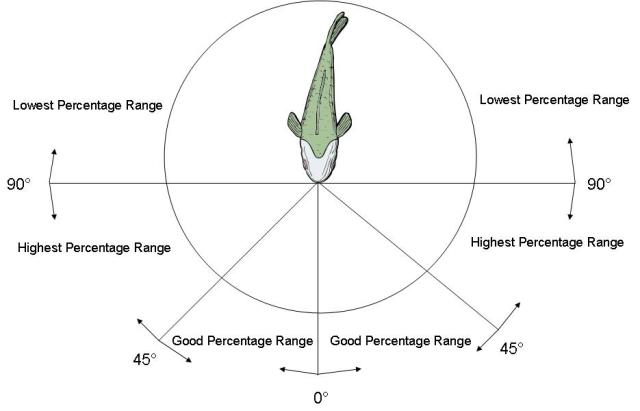
Proximity of the fish– I know, big words….what do they mean… The distance that you are from the fish is critical. I always have that urge to cast just as soon as I spot a fish. Granted, there is nothing like hooking a fish at a long distance and taking pride in the skill involved, but more often than not, those casts are the ones that failed. It’s beneficial to spot the fish at a greater distance, but better to wait until you understand what the fish is doing. If you spot the fish, but can’t tell what direction she is facing, your chances are only 50%. If you are patient and ease closer to the fish, determine the direction she is facing, your chances improve dramatically. Add to that, you can now make a gently cast, so that your offering lands without near as much commotion. If you are fishing in inches of water, this is critical, just like the sounds on the boat or wading, this can and will spook your fish.
Angle of attack– This one gets people all the time, at all experience levels. Don’t let yourself get in a hurry. Just like the distance above, the direction that you present the lure from can make all the difference in the world. Here’s what you have to understand: No species of fish, including apex predators like sharks, will eat an animal that swims directly towards their face. It’s not natural for any prey animal to swim directly at their predator. When you sight cast, this is blindingly obvious, you will see the scene played out over and over again. If you could sit and watch fish as they feed naturally, you would see, they always attack from the side or from behind. There is a funny correlation, think about the examples below. All of your short strikes, when blind fishing, are from behind. We often get a bite but can’t catch up to the fish fast enough to get the hook up. You never get a hit that immediately goes 180 degrees opposite of the direction of retrieve.
We have all dealt with this, but until you watch a fish’s reaction to a lure swimming at them, you may not make the connection, and yes I have tried with sharks in clear water. To the extreme, I have watched sharks greater than 5 feet turn away from a lure that was only inches, swimming towards them at too small of an angle. Next cast placed correctly, instant hook up!
Think of it this way, your casts should be at angles as near to 90 degrees, or perpendicular to the fish as possible. Your presentation should cross the path of the fish, close enough to be noticed, but not so close that the fish spooks. Vague, I know, but it varies from day to day and fish to fish. This is something that you learn from time watching fish in the water. There are 3 typical scenarios that you will see in shallow water sight fishing. 1) Tailing fish 2) Cruising fish 3) Laid up fish. Each is different and requires a different cast and “lead” to increase the odds of hook up.
Tailing fish, especially on the Upper Texas Coast, require a fairly close cast, often within a foot. On a calm day, I would say cast two feet beyond the fish, in a line where your lure will come within a foot or less as it passes the fish. This way you are less likely to disturb the fish when the lure lands, yet still will be able to get her attention. Some days tailing fish are so engrossed in what they are doing that this won’t work, then you have to present the lure closer. Start with more than you think is necessary then decrease. At least you won’t spook the fish before you get a decent shot. Pods of tailing fish are different. The biggest rule here is, don’t cast to the middle of the pod, pick the fish from the outside, and do NOT cast across the school.
Cruising fish, are often more challenging. Though they are usually up and feeding, they are now a moving target, where the tailing fish was nearly stationary. Again keep the angle as near to 90 degrees as possible, and watch the fish so that you can get a feel for speed and direction. Lead should be in the range of 2 & 2. In other words, the cast should be two feet beyond the fish, and two feet in front of the fish. Some days, this distance will have to be increased, such as ultra clear and ultra shallow water. The same would apply on a very calm day. Other days, you may have to land the lure very close to get the fish’s attention due to water conditions or fish that are actively chasing prey and changing direction frequently.
Laid up fish. These are probably the most challenging fish to catch. Typically, this is how I spot big trout. They are often up on the flats for the solitude and protection afforded there. They are out of reach of most predators, and away from the majority of the boat traffic. (If you own a tunnel hull boat and read this thinking, I can find them on plane. Please don’t! You only reduce the odds of seeing them for all of us). Laid up fish aren’t moving and typically aren’t feeding. They are however opportunistic predators and can be convinced to eat. It takes exceptional stealth to get near them and a great presentation most days to get their attention. I say that they are the most difficult because they are so hard to see before you are on top of them. When you do spot the laid up fish, presentation is critical. Make sure that your angles are right. An overcast (cast beyond the fish) that will allow subtle lure presentation and a crossing path, yet not be too close or too far. I guess that the perfect cast would cross the fish at about 12 to 16 inches ahead. If you get too close, you risk spooking the fish, too far and they just won’t move or even notice your lure.
If you are starting to get exited, welcome to my world. I have been living with these visions of fish lurching forward to eat my lures and flies for nearly 3 decades now. There are truly few things in inshore fishing that are more exciting than stalking a big fish in shallow water and executing a perfect cast. Especially when your perfect cast gets eaten and you get to watch the whole scene played out in real time. Adding the visual aspect to the fishing knocks the excitement level through the roof. It takes a lot of preparation, skill and a good bit of luck to make it happen, but when you do, you won’t ever forget it. Watching that fish “hunted” fish perk up, pectoral fins straight out, the kick of the tail, and then the gill flare as she eats. Now all you have to do is make sure that you don’t react too soon. Learning the proper hook-set is the final ingredient to the experience. I preach this method in all situations, sight casting and fishing with top waters are where it is most evident, but it applies anywhere that you can see or feel a fish bite. It goes back to how “does the fish eat?”, from behind or beside its prey!
When you see a fish take a lure, DON’T REACT!!!! Continue your retrieve. You can’t set the hook effectively until the fish has closed her mouth, and your odds will improve dramatically after the fish has changed direction. Think about all those bites that you couldn’t ever catch up to. The fish is coming towards you and it is just too easy to pull the lure right back out of the hole that it went into. When you see or feel the bite, continue the retrieve or reel down until the line comes tight to the fish. Usually, this will be enough to get the fish to change direction, and in most cases, if the line is already tight, you won’t have to set the hook much. If you feel the need, use a low to the water sweeping motion, not an upward swing. If you do pull the lure away from the fish, it won’t go as far as with an upward motion.
Now that you understand how and where to look, the subtleties of the approach and presentation, there’s only one thing left. Pick a day and get on the water for some new and challenging fishing fun!
Good luck and tight lines!

Autumn Weekends are for Snapper Fishing
Article written by David Sikes
October 24, 2010
Corpus Christi Caller – Times
http://www.caller.com/news/2010/oct/24/autumn-weekends-are-for-snapper-fishing
PORT ARANSAS — Miss Ann’s 16 cylinders rumbled patiently in her new berth, dispatching subtle ripples through still waters at Island Moorings Marina this past weekend.
It was a cool dawn with barely a breeze, promising the kind of gulf conditions that cause even the queasiest anglers to leave their seasick remedies behind.
The slips at Island Moorings were unfamiliar surroundings for the handsome Miss Ann, a well-traveled, vintage, 33-foot Bertram sportfisher owned by Bill L. Olson, Houston publisher of Texas Outdoors Journal magazine. On board for this trip was Olson’s son Billy, who ably assumed deckhand duties, and his angler friends David Roe and Daniel Bowman.
This would be the maiden voyage out of Port Aransas for the Miss Ann and the first time in years any of us had fished for red snapper in October. The ever shrinking federal snapper season has been a summer thing since the species was declared overfished about a decade ago. But dramatic management measures have yielded positive results. Anglers still must abide by a two-fish daily limit. But for the first time in years the fees recently raised the annual harvest quota on red snapper.
And you may recall last month when federal fisheries managers decided to reopen snapper season in federal waters to compensate for a lack of fishing during the BP oil spill.
The Fisheries Division of the National Oceanic and Atmospheric Administration determined that recreational anglers had caught only 1.1 million pounds of this year’s red snapper allotment, which was set at 3.4 million pounds.
So the agency is providing anglers a shot at catching the remaining 2.3 million pounds during a 24-day extended season that started Oct. 1 and will run through Nov. 21. To maximize recreational opportunities, snapper fishing in federal waters during this period is allowed only on Fridays, Saturdays and Sundays.
Judging by the smiles and piles of fish at offshore outfitter docks in Port Aransas, the return to fall snapper fishing has been bountiful. And as a bonus, anglers willing to endure the longer party boat trips are returning with a good mix of snapper and blackfin tuna.
What could be better?
That’s easy to answer. How about fishing in single digit winds with seas less than a foot. Throw in a few good friends and a comfortable boat and you have the makings of a remarkable fishing day.
I should mention that the classic Miss Ann has a patron saint. Ask either of the Olson boys and they’ll tell you that each voyage aboard the Miss Ann is blessed by her namesake, the late wife of Bill and mother of Billy.
Ann Olson succumbed to brain cancer in 2006.
She was a vibrant professional woman who enjoyed fishing and hunting and family. With Bill, Ann cofounded the Houston Chapter of the Rocky Mountain Elk Foundation, securing her place among Texas conservationists.
But Ann’s legacy embarked on an unexpected path when Bill got the urge to resurrect a 1987 Bertram about a year after his wife’s death. He bought the boat in Georgia from a man who had been called unexpected overseas on business for an extended stay. The boat needed some work. But it was a quick sale, probably the result of Bill’s newfound carpe diem (seize the day) attitude that had emerged from his recent loss. Soon, the boat had a new name and new life.
It would have been too much trouble to trailer her home, so Bill decided a family adventure was in order.
Here is where Miss Ann’s mission became clear. Bill could have hired someone for the job. But instead, three generations of Olsons — Bill, Billy and Bill’s dad, Sam L. Olson — bonded during a nine-day, nearly 2,000-mile voyage along the East Coast, around Florida and across the open gulf to Texas. The Miss Ann brought them together and then ferried them safety home.
Following a face-lift and major engine work, a renewed Miss Ann came home to Port Aransas where her patron saint continues to bring together the father and son she never left.
This past Saturday, the elder Olson beamed from the flybridge at the humor and harmony on the deck below. He motored out about 40 miles to a rocky area called Hospital. I couldn’t help but wonder whether the irony of bringing Miss Ann to Hospital occurred to her captain. I didn’t bring it up.
Billy rigged lines and set out five baits at various distances for the inaugural troll.
Within minutes three of the reels were squealing. We were hoping for wahoo or maybe blackfin tuna. Instead we had hooked three bonita or little tunny. We kept two for bait and released the other.
We trolled for a while between Hospital and the Aransas Banks, continuing to hook bonita when finally one of the reels sang with a higher pitch.
David Roe, an inexperienced angler who has not fished since he was a boy, grabbed the rod as Bill reined in Miss Ann’s 488 horses. The mystery fish certainly was not a bonita, judging by the strain on Roe’s face and the stubborn yank on his line.
Billy Olson coached while calmly playing the role of level wind so the line on Roe’s reel would be evenly distributed. The teamwork paid off handsomely with a 17-pound prize, a blackfin tuna.
We were about 42-miles out.
Where there is one tuna there usually are more. We assumed additional tuna were well below the surface. But those aggressive bonita wouldn’t allow a bait to get past them.
So we left in search of snapper, stopping a couple times along the way to set out lines where we saw birds and surface activity.
At about 22 miles from Port Aransas, the Miss Ann idled up to a platform with an audible warning siren blaring intermittently. Five boats clustered around the legs of the rig. I spotted three small snapper being caught and released as we approached. The Miss Ann had no intention of joining the crowd.
Bill steered the boat well to the left of the platform and began scanning his depth finder. We were at least 150 yards from the rig when Bill maneuvered the boat to a standstill.
“OK, drop ‘em,” he shouted.
Two of us hooked up immediately. Mine was about a 10-pound red snapper, a good sign.
For the next 45 minutes we yanked snapper from this spot. Most were in the 10- to 12-pound range.
This didn’t go unnoticed by the anglers aboard the other boats. One by one each of the boats backed off from the rig and lowered their lines.
After everyone aboard the Miss Ann caught a limit of snapper, Billy filleted one of the bonita and Bill steered the boat up to the legs of the rig.
We wanted to try for a grouper with bigger baits.
But it was impossible to avoid the snapper. So Bill turned the bow westward and the Miss Ann brought her satisfied crew safely home.
Federal red snapper season is open Fridays, Saturdays and Sundays through Nov. 21.
Charter boat opportunities Port Aransas
For smaller charter boats (33-foot and smaller) fees generally range from $900 for two anglers; $1,000 for four; and $1,100 for six.
On larger private charter boats, fees generally range from $1,500 to $1,600 for an eight-hour trip with up to six anglers.
To book a trip, contact the Texas Charter Fleet at 866-893-5338 or e-mail info@TexasCharterFleet.com.
Party boats offer more affordable trips with a less intimate atmosphere.
Deep Sea Headquarters (800-705-3474) offers daily eight-hour trips for $85 and 12-hour trips on Wednesday and Saturday for $105. Snapper are off-limits on the Wednesday trips.
Fisherman’s Wharf (800-605-5448) offers a nine-hour snapper trip each day of the season for $85. And on Saturday they’ll offer an 11-hour snapper trip for $100 and a 12-hour overnight trip for $100.
Dolphin Docks (800-393-3474) has daily 8.5-hour snapper trips for $86 and 12-hour night trips on Fridays for $105. Dolphin Docks also will offer a 12-hour day trip from 6 a.m. to 6 p.m. on Saturday for $105. Ask about Dolphin Docks’ longer trips (depart Friday and return Sunday) during the season.
David Sikes’ Outdoors columns run on Thursday and Sunday. Contact David at (361) 886-3616 or sikesd@caller.com


Fly Fishing for Tarpon – Anegada
Good fishing in store for weekend anglers
By Joe Kent
Published October 16, 2010
The recent cool front has passed through, and it appears some excellent fishing will follow this weekend. The calm conditions forecast for today and Sunday should generate a lot of activity on the water.
Pelagic fish are being caught around the jetties, and tarpon are reported to be in West Bay. Reds are hitting in good numbers, and just about all other species are being taken. Fall is upon us, and the fishing is picking up.
Now, let’s take a look at where all of the action has been taking place.
More than 40 keeper fish were caught at the South Jetty (Gulf side) aboard Aqua Safari Charter’s Island Girl on Thursday for a party of seven.
Most of the fish were caught in the morning on Spanish sardines fished top and bottom.
The catch included one ling, 54 inches, one 20-pound kingfish, nine blacktip sharks to 30 pounds (boat limit), 26 large Spanish mackerel, one jack crevalle (released), three bull reds tagged, one cow nose ray released and many additional sharks, released.
My good friend James Selig, who has not been fishing in about 40 years, was talked into it last Saturday night by his Houston buddy Michael Bossart and his young daughters Collette and Isabella. The group spent their time at the Seawolf Park Pier where Collette managed to catch three fish at one time, plus snag a stingray, as did James and Michael.
The stingrays eluded eventual capture, Isabella proved she could sleep anywhere and through anything, and all had a great time. Perhaps this will trigger Selig’s renewed interest in fishing.
There was an unconfirmed report of a tarpon being hooked at the Tiki Island bridge by an angler fishing from a kayak. The big fish dragged the kayak to Jones Lake, where the angler eventually got the fish alongside. The silver king appeared to be 48 to 52 inches long and was released.
Opa Miller fished grassy areas and drains in Campbell’s Bayou and had a field day catching reds. Between 6:30 a.m. and 9 a.m. the Texas City angler landed 13, with six exceeding 28 inches. Large live shrimp was the bait, and all of the fish were released except two.
Lloyd and Cookie Pepper, two of the legends in Galveston area fishing, are involved actively with Sea Center Texas’ youth program. Today, they are offering a free fishing day for kids younger than 15 at the Lake Jackson facility from 10 a.m. to noon. The kids need to bring their own rods and reels and bait. The fishing will include the use of hooks without barbs.
For information, call Lloyd Pepper at 409-737-1136.
To get your catch in the Reel Report, phone Capt. Joe Kent at 409-683-5273, or send an e-mail to reel.report(at)galvnews.com. There’s no charge for this service.
+++
Tourney Results
Here is a list of teams that placed in last weekend’s West End Anglers West Bay Redfish Showdown Tournament.
1. Team Notorious
2. Team Third Stone
3. Tail Chasers
4. Team Reely
5. Team BAFM
6. Albert’s Hammer
7. Team Fish-N-Hunt
8. Tall Tails
9. Team Ibtsoom
10. Half Taco
11. Popovich/Soule’
12. Too Legit to Quit
13. See N Spots
Fall 2010 Newsletter
 |
|

|
|||||||


[SUBSCRIPTIONS]
Reef fishing is in its prime
|
Lutes Marine & RV
6811 CR 203
Liverpool, TX 77577
281-393-1021Read More
Calculated Approach
Calculated Approach
Captain Steve Soule’
It isn’t frequent that the average bay angler takes time to plan their trip out in depth, or consider all of the details of the day ahead. If you look at the most successful anglers around the coastal waters you will find that they leave very little to chance. These guys and gals who fish tournaments and take customers out to earn a living can’t afford to take a haphazard approach to fishing. They may seem relaxed and fish may appear to flock to them, but very little happens that wasn’t expected. This isn’t a result of researching reports in the news papers and on the internet, or listening to radio shows. These plans are typically founded in years of on the water research and an intimate knowledge of the waters that they will fish and the species that they target.
It seems that today, more than I can ever remember seeing in the past, anglers are yearning to catch what the pros catch. The biggest problem is that they don’t recognize the effort that went into each successful day. None of the top pro anglers got to their level of success without a huge investment of time, money, frustration and desire. So, how does an angler new to the sport of fishing and craving a greater level of success in their personal fishing get to that level? The answer is neither simple nor likely to be what most readers would want to hear. It is however, the best and most fulfilling way to truly learn to catch, more, and bigger fish consistently.
To find success in fishing and create consistent and repeatable results, you need a plan. Unfortunately, not just any plan will work. The plan must be founded on known truths, most of which can only be found with first hand experience. For those unsure about how to create an effective plan for a great day of fishing, here are some guidelines.
Start with what knowledge you do have, add in some that can be gained from current local informational sources, and understand the factors that can and will affect your day. If you have knowledge of an area, this will probably be one of your best starting points. With that foundation of understanding of the area, you only need to look for the "signs" that your chosen location is holding fish today. Hopefully, the familiarity of the area allows you to know the tide flow and level, wind direction, and other pertinent water conditions that work well. There are days when you can "force" a pattern to work, but for most days, and most anglers, this isn’t a recipe for a fun day of fishing. Again, knowledge of more areas, especially of those that differ not only in location, but terrain as well, will help you achieve success in catching.
I always urge people to explore. This has saved me as a guide and tournament angler more times than I could ever remember. Exploring doesn’t just refer to driving off to a new location twenty miles away. Exploring the general area you fish, and water and shorelines adjacent to them, can often lead to a greater understanding of how the fish move within the area. These are the things that you need to know: where the fish are positioned on different tides and at different water levels? What are they feeding on and when do they want to eat? Do they feed in a distinct and defined area within the larger area? If they leave the immediate area, where do they go?
A great example of this is one of my favorite reef systems in the Galveston Bay Complex. This particular reef structure is fairly long, and very diverse, encompassing shallow and deep water, mud transitions, guts, and even a few small flats. Due to the reef’s orientation, both tide and wind can have a profound effect on the water flows around the reef. For years, my understanding of this reef was very simple. I knew it had a shallow ridge that exposed itself on low tide and the general area was mostly shell bottom. But, after many years of drifting and wade fishing the area, I can now identify at least 7 distinct guts in and around the reef, shallow flats in several areas and several very distinct feeding areas for the big trout and redfish that inhabit the general area. I can tell you on most days, in most conditions, which part of the reef the fish will most likely be on and when they will most likely eat. Again, nothing beats the time spent exploring and understanding the areas that you fish.
I have said for years that a drift-only angler will never have the kind of intimate knowledge that a competent wade angler will develop. This isn’t to say that you can’t learn well from a boat, it just takes longer to develop the same kind of understanding of the area. When you are drifting, you absolutely have to monitor the depth finder and note the various depth changes in an area. You will have to drift and repeat, numerous times, as you are only seeing a "small slice of the pie" that is directly under the boat; whereas, a wade fisher can zig-zag across the area and piece the puzzle together much faster.
So what are the key elements of the plan, and how do we develop a successful one? The answer has several important pieces. Know your weather conditions! Know your tides! Know both flow direction and level! Know the primary forage species that your targeted fish is currently dining on! Know the timing of when the fish are feeding best! With all of those things said, the single most important piece of your plan should always be: Know when it’s time to adjust your plan!!
Knowing your weather! This is fairly simple. Turn on the TV or get on the internet and you can find the pertinent details for the day. But you need to be able to relate what you see or read to what will happen at the spots that you intend to fish. Wind direction can be critical to water clarity and levels. It can also take away the ability to cast comfortably to the area that you want to target.
Knowing your tides! This is also just a click away on the internet. Find a reliable source for tide level and direction of movement. These two components can be two of the biggest determining factors in your success in saltwater fishing, especially if you are in an area that sees big swinging tides or the opposite where the tide movement can be nearly non-existent. If you fish back-bay areas, you would want the bigger tide movement days to move the prey species. Conversely, if you fish near a gulf pass, strong tides often make fishing very difficult as the bait and fish are literally flying by in the tide.
Knowing the forage species! For trout and redfish, there are a handful of forage species that are consistent throughout most of the year. Mullet are a year round target. Shrimp are prevalent during spring, summer, and fall. Shad show up during the spring and remain through the summer. The list goes on, but it can be important to know what is there and when they will be the primary target. Knowing the target prey can help in selecting lures and baits to improve success.
Know the timing that the fish are using to feed! This timing is usually related to one of only a handful of factors. Tide movement – usually fish will be on a pattern of feeding in one area during the incoming tide and another area during the outgoing tide. These may not be far apart, but will almost always relate to the way the tide will flow through the area and around the structural changes found there. Light, or lack thereof – fish will feed on certain species during certain light level conditions, mostly due to their ability to ambush that particular animal most effectively. Frontal passage can bring huge feeds, but its my opinion that it has the utmost to do with the change in barometric pressure. Knowing this, you can pick some things from your weather report that may help your day. Most of the time this is just something that you are effected by rather than planning on. I do however try to plan trips around impending pressure changes to see improved success in big trout fishing.
Know Moon phase and timing of position! This is something that you can definitely use to your advantage, and again, it’s readily accessible on the internet. All fish and animals tend to feed following a moon schedule more than any other factor and knowing the timing of rise, set, directly over and directly under, can have a huge impact on your plans and fishing success or failure.
What’s the impact of this knowledge? Well, you won’t know until you try, but here’s a few interesting stories from recent months that help to substantiate what I’m suggesting. Last week was a great example. I had been trying to make plans with my tournament partner, Daniel Popovich, but my work schedule wouldn’t allow. He ended up fishing one of our favorite shell patches on Monday evening, in what wouldn’t seem like ideal conditions .The wind was blowing at nearly 20 mph, it was very cloudy, somewhat foggy, and occasionally drizzling. Not that we haven’t seen these conditions produce huge stringers of trout in the past, and this day was no exception. He landed 9 trout that afternoon, between 22 and 27 inches. Of them, two were over 7 pounds and 3 others were over 5!! This was a classic case of knowing the spot, weather, and tidal conditions. The fish are also fairly predictable about feeding on the moon. I think that it was setting during the period when the best bite was going.
During every single one of the 5 tournaments that we have fished since December of 2009, our trout will consistently feed on the moon position. Obviously, we can’t plan to have a specific moon phase or position, but we go into each and every day knowing when to expect the best bite and making sure that we are in the area where we have the greatest confidence at that time. Another interesting note, they will feed even more aggressively when the moon hits a certain position, coinciding with a shift in barometric pressure.
During our second tournament in December, we spent seven hours without a single bite, but at around
As you develop that understanding of the areas that you fish, you will likely learn the smaller areas within that area that the fish actually feed in. Then you can better understand how the tide will effect where they will be positioned, given a certain level of water and direction of flow. Add to that the knowledge of which tide they are using to feed the most and when the moon will motivate them to a peak of feeding. From these conditions and your knowledge of the fish, and experience in the area, you start to understand better how to approach the area, as well as the fish. Then, you are more likely to be in the right spot at the right time. You can begin to take some of the guess work out of your fishing and fish an area with confidence. These things won’t guarantee you fish every trip, and there really aren’t any absolute truths to fishing, but you will be several steps closer to catching fish every trip. Think of it this way, you won’t catch fish at every spot, every day, but if you can eliminate a spot in a much more efficient manner, you can move to another that may be working. Eventually, you will find one that works on even the most difficult of days.
The final piece in developing plans for angling success, is understanding what has happened while you are on the water and keeping accurate records. I am as guilty as anyone of not recording some of the best information that I have learned. I’m a hit and miss log book angler. Fortunately, I have a better memory of fishing than I do of virtually anything else. Now, my family will not agree with me that this is a good thing, but as far as my fishing career goes, it’s been very helpful. If you recognize the importance of your logbook, here’s a few important things to keep track of: weather conditions, such as, wind direction and speed, cloud or light level, air and water temperature, water color and clarity, available structure in the area, activity of the bait, barometric pressure, tide level and flow direction, and of course the bait that you used. Don’t forget to log the bad days along with the good. It is every bit as important to know what didn’t work. I would far prefer to eliminate non-productive areas quickly rather than stay in an area trying to force something that isn’t going to happen. It isn’t always easy to understand exactly which factor is the cause of success or failure as they are often in conjunction with other factors. The more you watch and record what you have seen and experienced, you will find that your ability to locate and catch fish will increase, along with your ability to eliminate water.
So you can see, developing a plan, based on the current conditions, your knowledge, from recorded data, or that of others that can be borrowed. Knowing your target and the food that they are eating, and then understanding the timing can most definitely lead to greater success. This understanding will most likely will translate to much more fun in your personal or professional fishing time.
Good luck and great fishing!